Oct 16, 2026/Result/Quantum computing
Building the resource frontier for Shor’s algorithm on Elliptic Curves
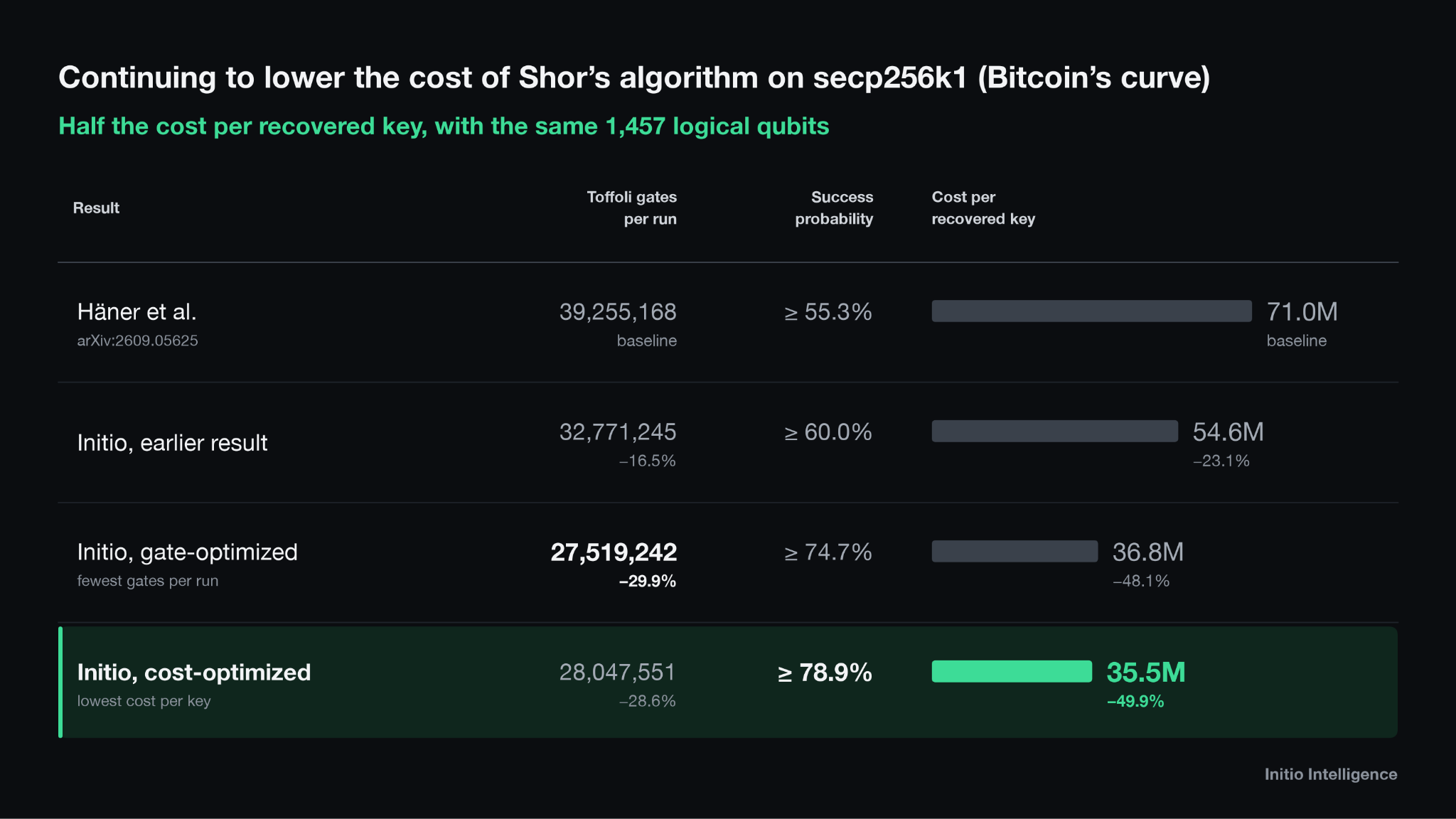
We continued running autonomous research to further reduce the resources required to run Shor’s algorithm on secp256k1 and P-256. With the same 1,457 logical qubits, our shortest circuit now requires 27.5M Toffoli gates, while simultaneously increasing the success probability (at least 74.7%) of the algorithm under the same assumptions for classical post-processing1. A second circuit with the same qubit count further increases the success probability to at least 78.9%, reducing the number of Toffoli gates per recovered key to 35.5M. This is almost 50% lower than the Häner et al. estimate published in September.
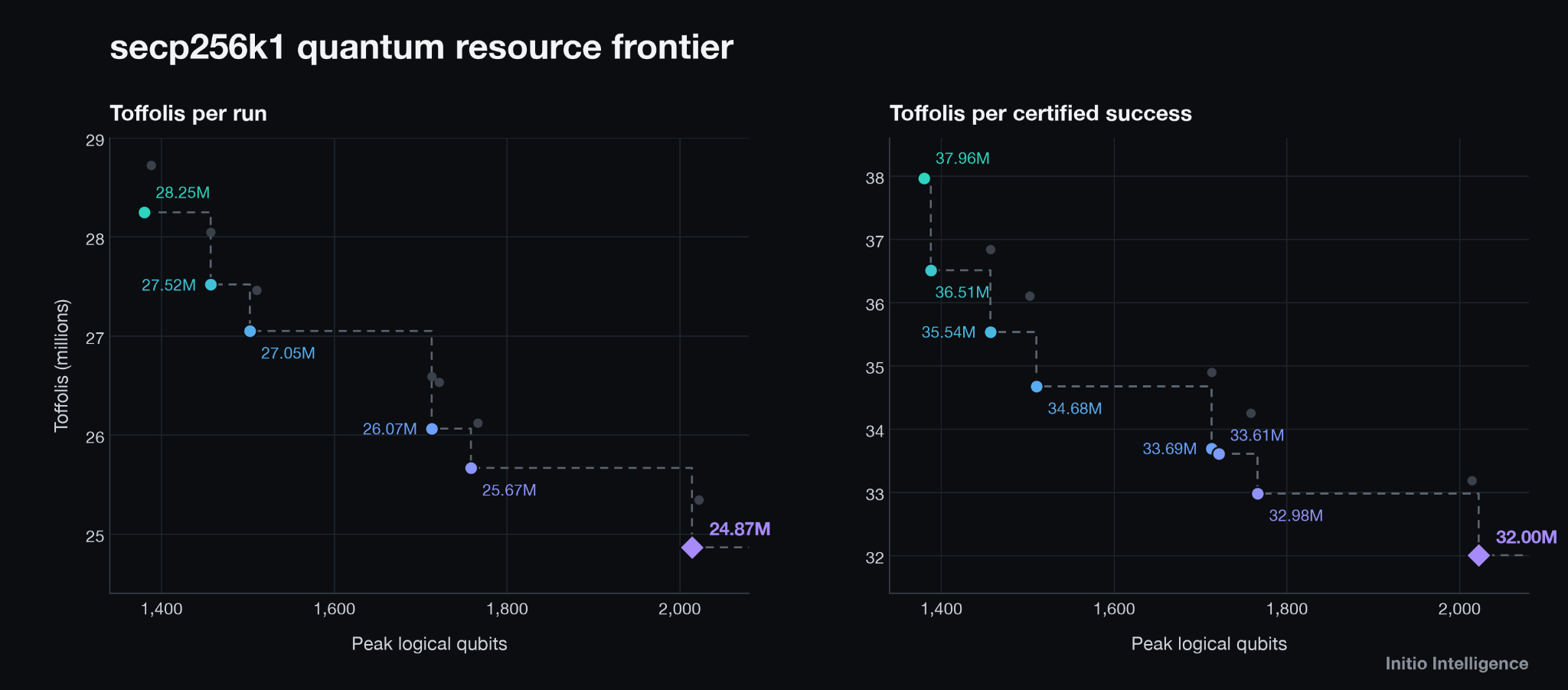
Using our system, we can map the tradeoff between qubit number and gate count and build a resource frontier that relies on the collection of techniques discovered to date. It ranges from 28.25M Toffoli gates at 1,380 qubits down to 24.9M at 2,014 qubits. Note that we did not use the same amount of compute to optimize across different qubit counts, and further reductions are very likely.
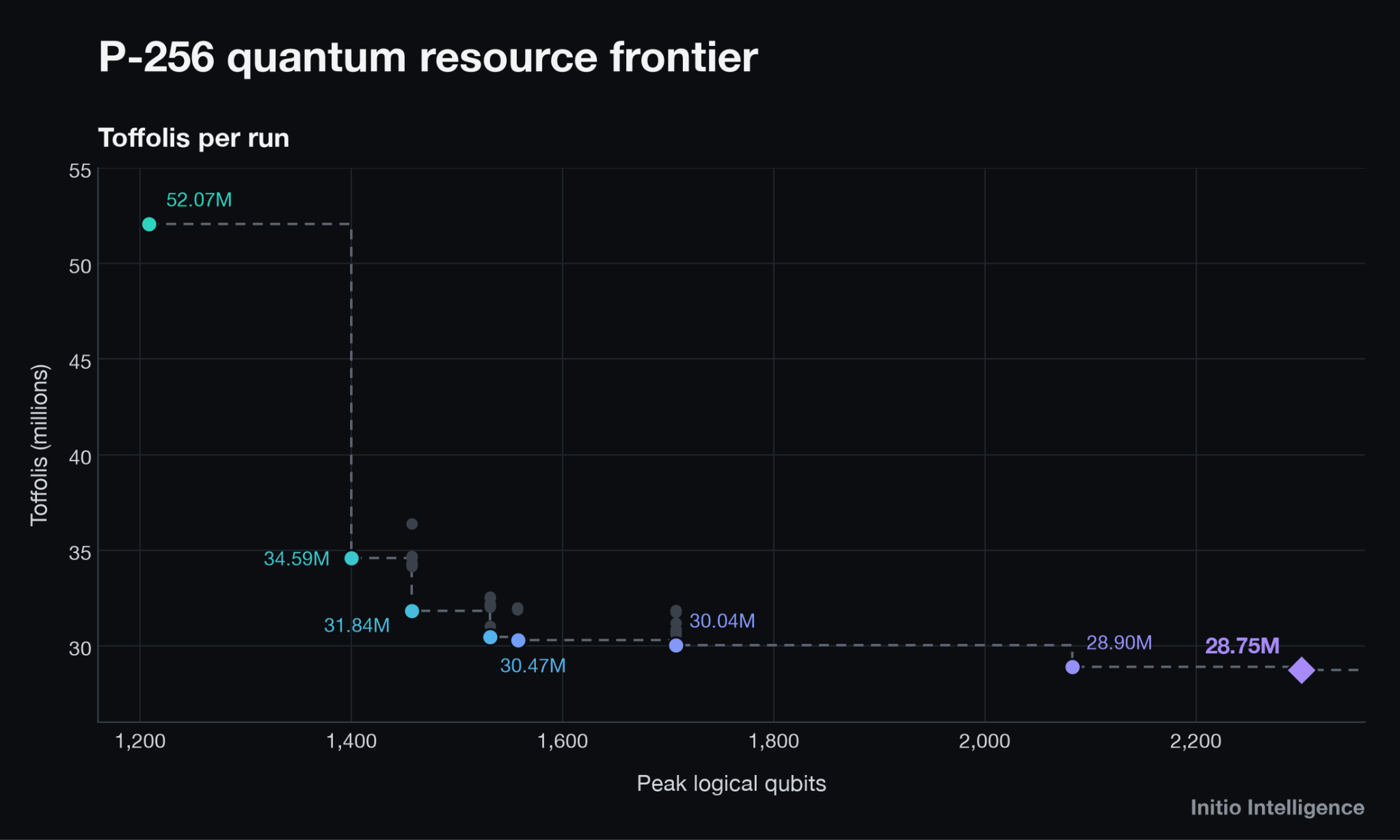
We also applied similar techniques for P-256, a NIST-standard elliptic curve for digital signatures (ECDSA) and key exchange (ECDH). The resulting graph is below.
A new paper describing the constructions and their resource counts is available here.
Footnotes
-
By allowing more classical post-processing per run, the success probabilities rise further. Section 9 of the paper describes this. ↑